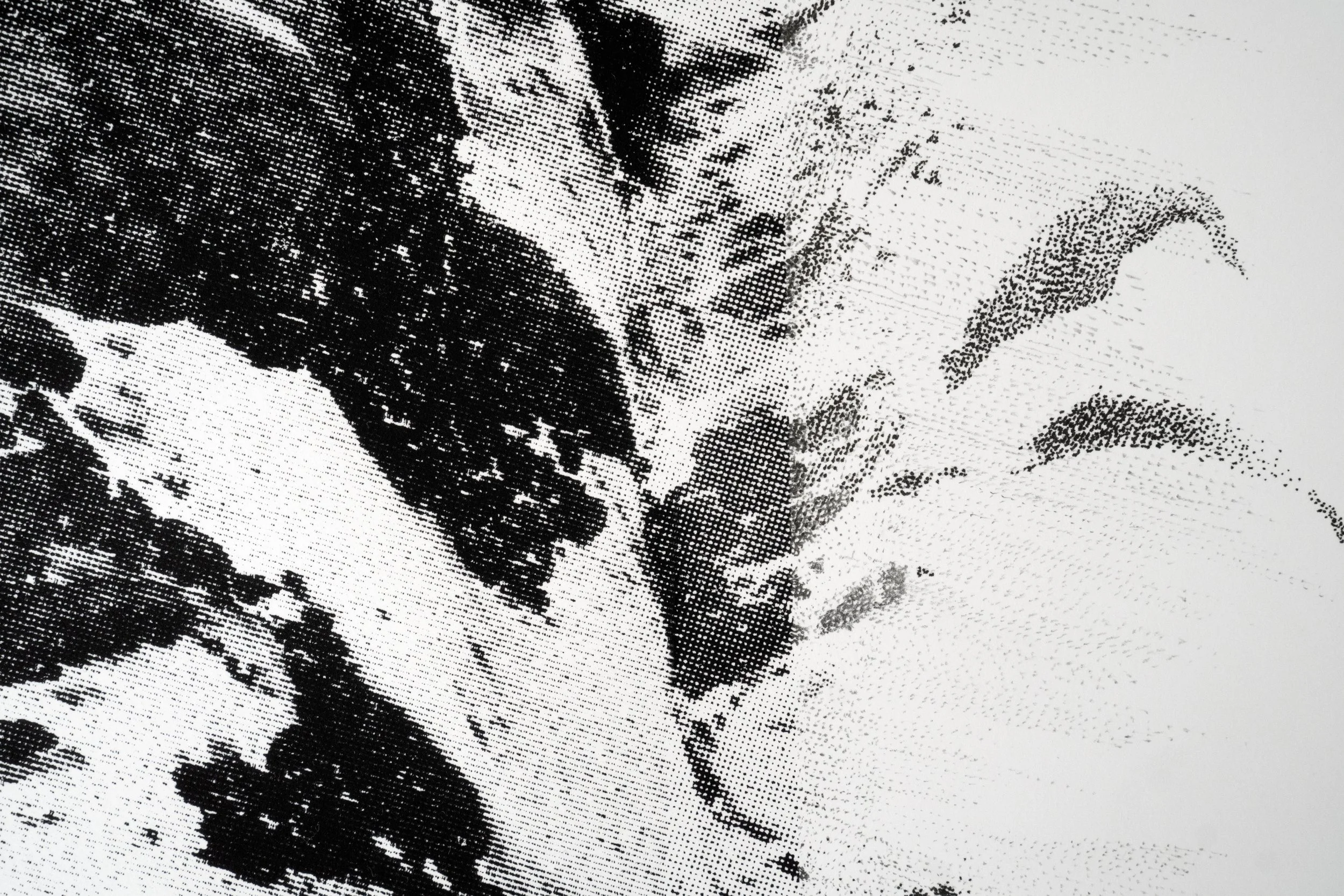
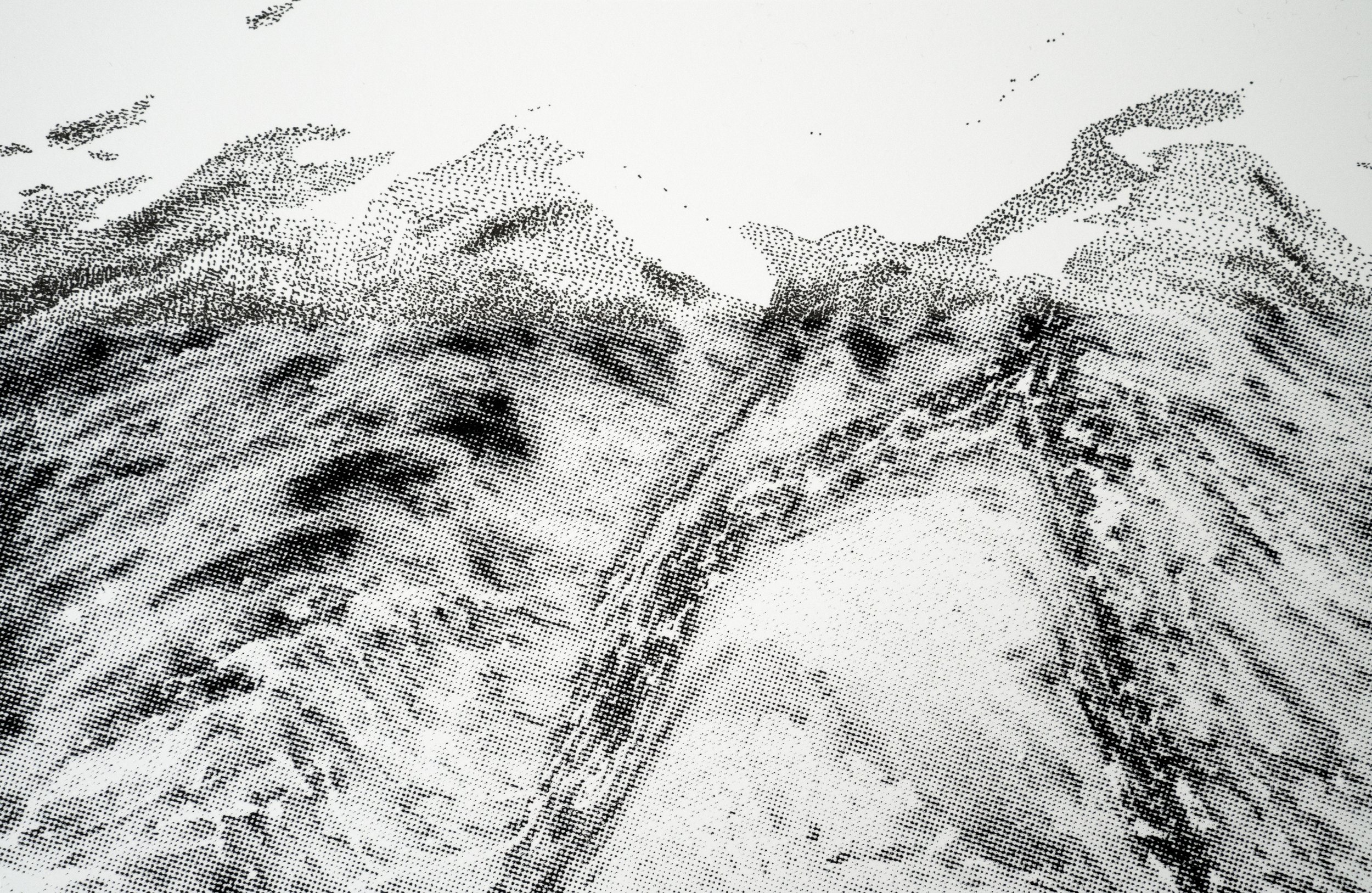
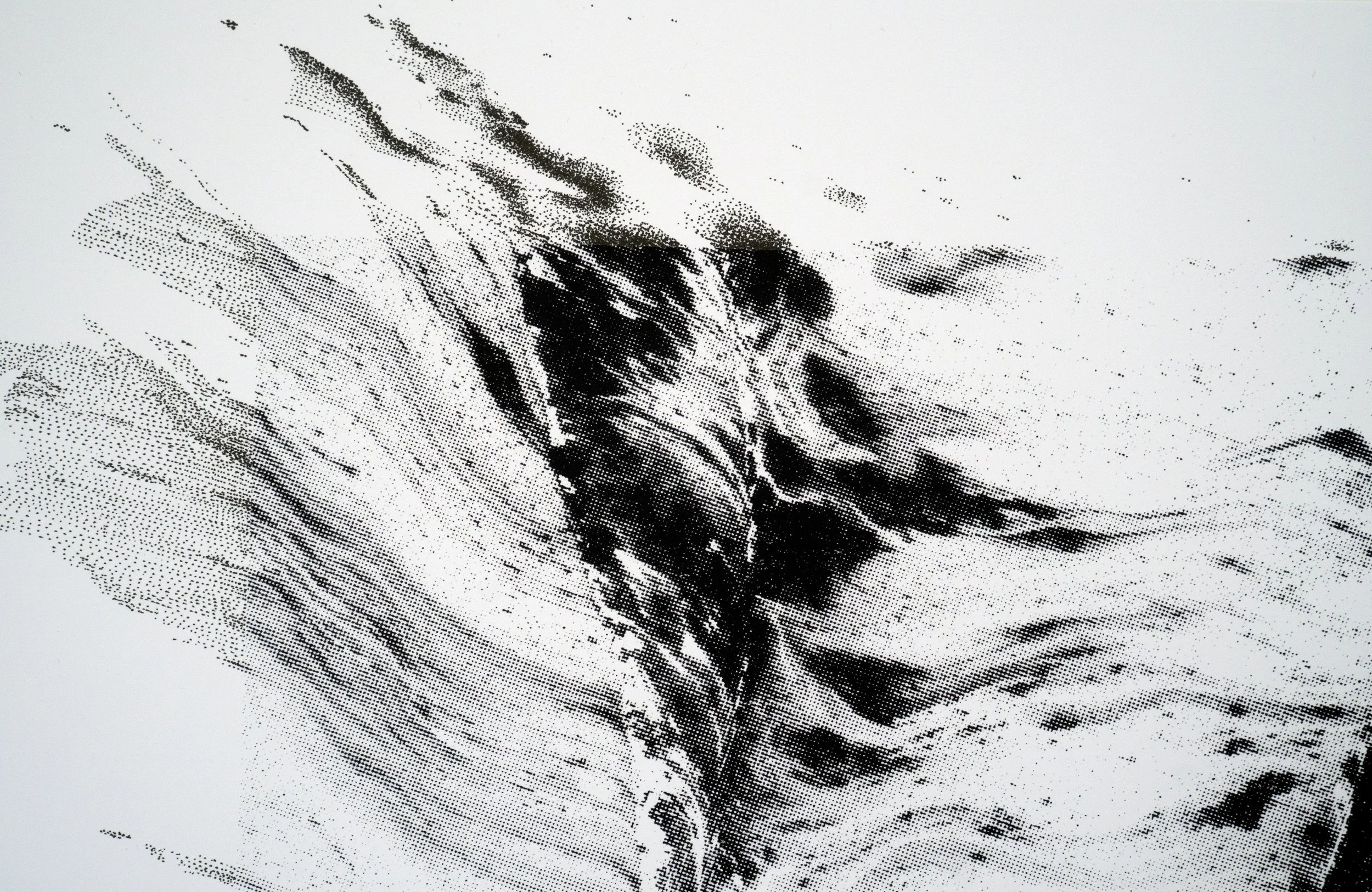
Droplet from a Water Drawing. Dissolved.
Droplet from a Water Drawing. Dissolved. screen print, drawing, 84 x 59.5 cm, printed at Grilse Gallery, 2025
I often imagine how a drawing could extend beyond the rectangular boundaries of the paper. Even the two pieces in my bedroom - the ones I hesitated to hang - I still look at them and mentally stretch their edges outward. It’s a quiet exercise I can’t resist, or rather, I’m not always aware of it until I catch myself doing it again. I can’t decide whether I’m after an overall interconnectedness of things or rather the entropy within these drawings, which I execute in my mind.
So when Grilse Gallery made a print screen from a fragment of one of my Water Drawings - the fragment I selected and photographed - the idea stayed with me. Once the drawing was translated into a new medium, I started adding dots around its edges in my mind.
A dot. The smallest mark I can make. The mark that makes the drawing. It is the space between the marks - larger or smaller - that creates movement in my work. The space between two dots disappears from a distance. How many things disappear from a distance? How many only reveal themselves when you step back? I like this walking back and forth with my drawing: seeing, not seeing, seeing again.
I drew dot after dot, studying the print screen and how its shadows and movements formed. I tried using pencil, but the reflection of graphite didn’t work well with the print. So I turned to the pen. With a pen, there is no erasing, no undo. From working on my large charcoal pieces, I’ve learned that a small mark is a point of observation - it creates relationships with everything around it. Here, too, a single dot becomes a reference for everything that comes next.
After working like this for a while, I noticed the drawing starting to take on a life of its own, as it usually does. I followed its lead, walked around it, and spent “non-drawing time,” which I always need to explain to myself is the most precious - it is about seeing. Seeing, walking, again not seeing.
Eventually, I thought: maybe it’s safe to leave it at this stage. It looks good. But I’m not interested in safety. I want to know what lies beyond it.
I considered making a sketch on a separate piece of paper to place beside the work, to see what might happen. But that felt boring - it wouldn’t be alive in real time. I would just be recreating something twice, and the search would lose meaning. I would already know the answer. That would be more about the finished product than the process of making it.
What interests me is finding the answer in real time. Isn’t that how life works? We don’t get a trial run.
As Merleau-Ponty wrote, “The world is not what I think but what I live through.” (1962; quoted in Installation Art as Experience of Self in Space and Time, p. 24)